
Girona Art Museum
The exhibition is dedicated to the work and figure of the Catalan-Chilean artist Roser Bru i Llop (Barcelona, 1923 – Santiago de Chile, 2021). Roser Bru was born in Barcelona and experienced her first family exile in Paris at a very young age, during the dictatorship of Primo de Rivera. Back in Barcelona, they lived through the proclamation of the Republic and then a second and permanent exile that would take the family first to France and then to Chile, on board the ship Winnipeg, chartered by Pablo Neruda, who was then consul in Paris.
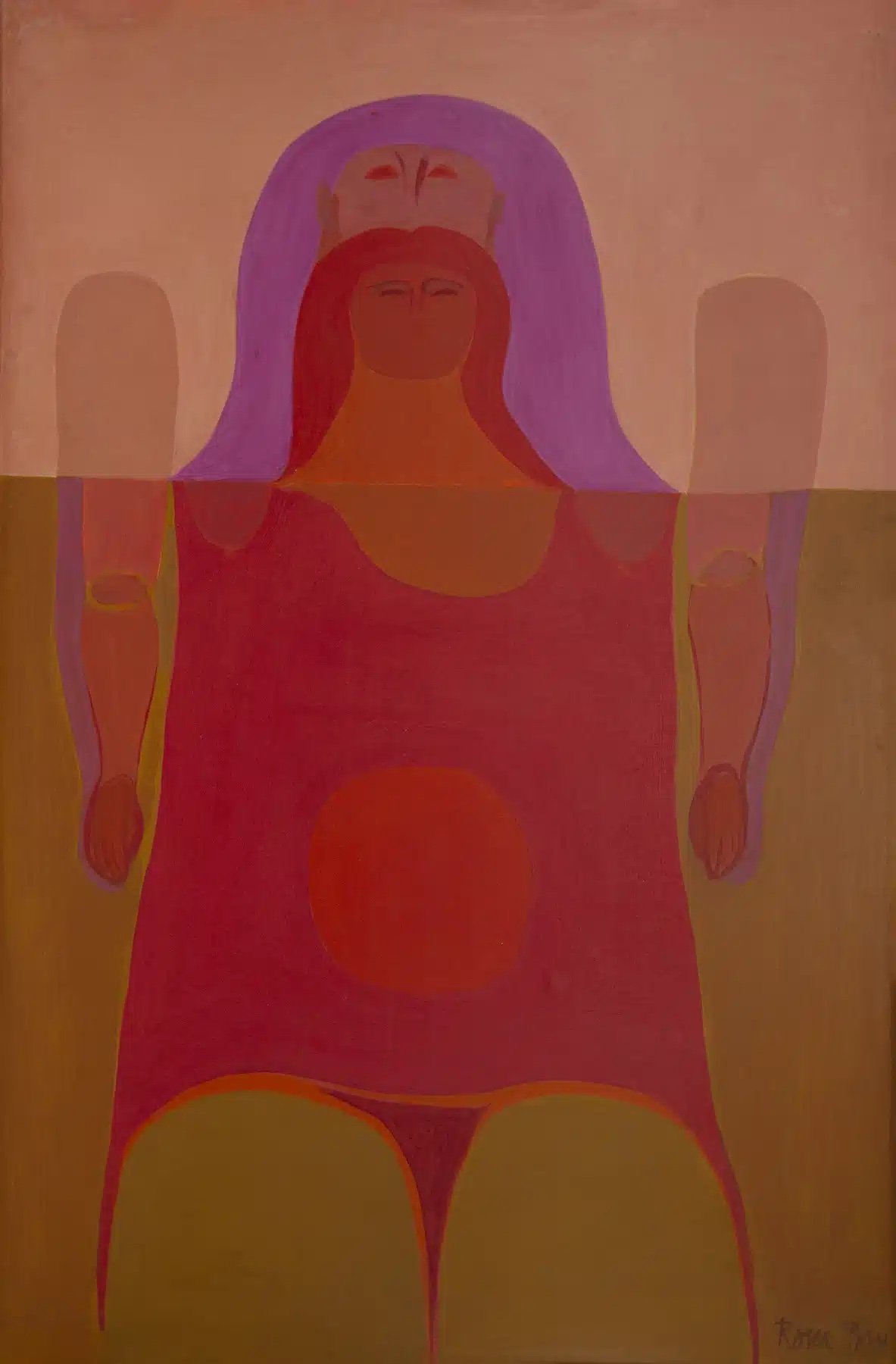
Roser Bru studied Fine Arts in Santiago and maintained a close friendship with Neruda, as well as with other Catalan exiles, especially the writer Montserrat Abelló. In fact, although she developed her entire artistic career in Chile, Bru always kept her Catalan roots and contacts with Catalan artists and writers alive. Her early work was influenced by the iconographies of the Catalan Romanesque, especially the totemic figures of the virgins, and there is also a clear influence from Catalan Informalism, especially the work of Tàpies, whom she discovered on her first trip back to Catalonia in 1958.
Painter and engraver, she became one of the most prominent and recognised artists in Chile, where she was awarded the National Prize for Plastic Arts in 2015. In 2018 she received the Spanish Gold Medal for Merit in Fine Arts, in recognition and homage to her persona and oeuvre. Five years later she was honoured with the Sant Jordi Cross from the Government of Catalonia.
Bru died in 2021 at the age of 98. Just last year the centenary of her birth was celebrated in Chile, which is now being extended with the exhibition at the Girona Art Museum.
The exhibition at the Girona Art Museum, entitled ‘Roser Bru, Overcoming Distance’, allows us to see Bru’s work in Catalonia again after almost 20 years. The exhibition, co-curated by Àlex Mitrani and Inés Ortega-Márquez, aims to highlight Roser Bru’s Catalan origins, as well as the emotional and artistic ties she maintained with Catalonia. In parallel, it aims to revive her persona and career, with a proposal based on three subject based axes – female iconographies, democratic demands, and humanistic and geographical benchmarks – as well as revealing the dimension of Roser Bru’s work and making it present, once again, in Catalonia.
The exhibition project is being developed and has received the encouragement and support of the Chilean embassy in Spain and the Chilean Ministry of Culture, and the collaboration of the Roser Bru Foundation in Chile, as well as special support from the Ministry of Culture of the Government of Catalonia and the accompaniment of the Ramon Llull Institute and Casa Amèrica Catalunya, among others.